When my professor brought up the fact that he did not feel he really understood something unless he could explain it to his child, I automatically thought of a quote from this man:
"If you can't explain it to a six year old, you don't understand it yourself."
— Albert Einstein
I have some of my favorite quotes saved on my account for Goodreads. When I thought of this quote, I was able to search my favorite quotes and found the one I was searching for. For a girl who is obsessed with quotes, the Goodreads site has been wonderful for me.
This is one of my favorite new sites. Musicians are able to get their music out there for other people to listen to, comment on, and attend shows. Like the tagline on their ReverbNation’s website says, “The best tools for musicians and the best music for everyone else.”
I have discovered many artists from my hometown area and from Provo, Utah, where I attend school at Brigham Young University. The benefit of doing this is finding local shows for these artists that you can attend. I discovered this site when my friend, Jesse Jones-Blair, an aspiring musician, sent me an invitation to become a fan of his page. I soon began exploring other artists have even downloaded some of their songs that are available. I am also planning on attending a free show of two local artists here in Provo next weekend.
One of my favorite local artists is Nik Day. He has a style similar to Michael Buble, Jason Mraz, and John Mayer. Below is a music video of one of his songs called, “How Could Life Get Any Better.”
I really enjoy this site for its possibilities for music exploration and discovery. If you have any interest in music whatsoever, I recommend this site to you. There is music for everyone, including the music of one of my favorite pianists, George Winston.
While talking with my co-worker about what my blog for my English 295 class was for, I used the phrase "consuming to create", which led to him telling me about a certain creator who I will speak more about later in the post. We went on to talk about what is "creativity". Everything that human beings create came from somewhere, whether that be the work of someone else, the person's surroundings, or the creator's personal experience. To quote Albert Einstein, "Creativity is knowing how to hide your sources."
Like the creator Albert Einstein, another creator or two have some words on the subject:
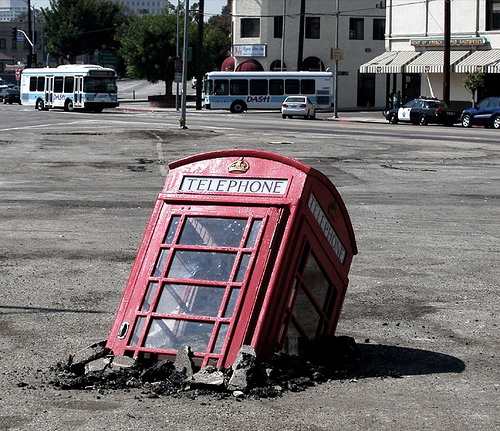
We all probably know who Pablo Picasso is, but the creator that my co-worker told me about is Banksy. Banksy is a grafitti artist from England. His identity is unknown, but his work is seen and known in many places around the world, commenting on social and political issues.
The above telephone booth is the work of Banksy in downtown LA.
This link leads to another London telephone booth work by Banksy and some other results of creativity at work.
My co-worker and I also discussed what determines the value of the work someone produced. He commented that a lot depends on where the work came from. As an example, wise words always seem to be more profound to a reader when he/she knows the quote came from someone famous. Jay Leno said, "You're not famous until my mother has heard of you." Blogging is one way to get your ideas out to the world, show your creative voice, while utilizing the information at your fingertips. You never know, one day someone's mother may have heard of you.
This is my new cute little nephew, Benjamin Jesse Lewis, born on May 8, 2011 (yes, he was a late Mother's Day present for my sister-in-law). Everyone is so excited to welcome Ben to the family!
I went over to visit my brother and his family on Sunday afternoon, only to discover that the baby was on its way, and I was the designated contraction timer. None of us could remember if you were supposed to time the contractions from the beginning of the last one to the start of the current one, or from the end of the last one to the beginning of the current contraction. Our first thought, consult the Internet. Consult I did to find a search result for a site called Contraction Master: Your FREE, online contraction timing assistant! This site was started by a husband and father who was frustrated with the typical pen and paper process of figuring out contraction times, durations, and frequencies. Not only did this site answer our question (the answer is from the beginning of the past contraction to the start of the current contraction), it provided a much simpler and accurate way of keeping track of the information while being able to help out with other tasks that needed to be completed before the parents headed to the hospital. Ben was born just a few hours later, and everything went well.
When I was younger, you found out about a birth within your circle of family and friends through word of mouth, by talking in person or on the phone. Then, people began utilizing the Internet, sending out e-mails to announce their child's birth. Yesterday, my brother did call immediate family to announce the birth, but most communication was done through other streams of communication. Before Jason and Heather even left for the hospital, they posted on their blog and sent out text messages to let everyone know that it was GO TIME. At three in the morning, less than four hours after the birth of their newborn son, Jason texted and posted again with birth information, pictures, and how mommy and baby were doing.
It is for events like this that I feel so blessed to have modern technology in my life. Both positive and negative effects can result from technology, just like anything in life. In this case, technology was wonderful, allowing family and friends to gather virtually together to celebrate a special event.
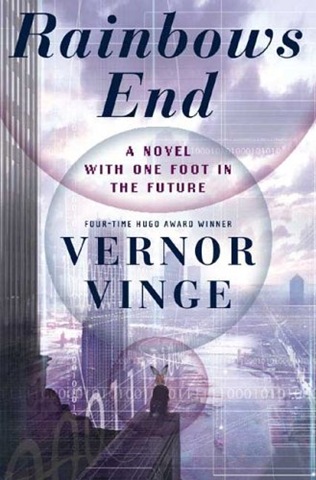
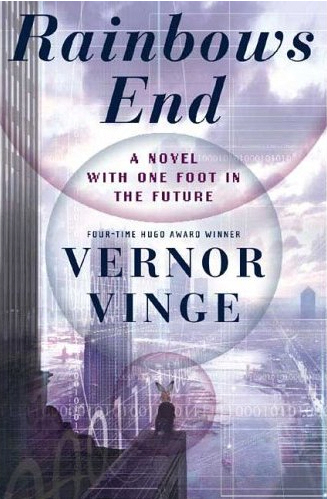
The book Rainbows End was both intriguing and frustrating to me. The continuity of the plot was off in my opinion; Vinge's approach of starting off with a conflict and getting you interested and excited about it, leads to endless pages where the initial conflict is barely mentioned, to only jerkily return to the conflict at the end of the book. Both times that the storyline changed this dramatically it felt like hitting a wall. You had to pick up the pieces of new information (and your brain) and follow the new conflict presented. I enjoyed Robert Gu's journey of being reintroduced into a world all new to him, and how he reacts to the prevalence of technology in this world and his new role in this world. However, it was frustrating, because I do not feel like either storyline was tied up as neatly as I would have wished. Looking up information online, I found that a sequel is rumored to this book. Part of me wants to read this new novel to see if the storyline would have a more complete ending to me, but part of me does not wish to bother, having already been disappointed with the ending of the first book.
Overall the book was successful in raising interesting questions about the future of technology. How much control are we giving over to technology? How plugged in are we into the technological world, and is that level too absorbed to be capable of relying on ourselves, or perhaps too unabsorbed so that we cannot function successfully in today's society? This book may have been set in the future, but like many futuristic novels, Rainbows End is a mirror in order for us to take a good luck at ourselves today.
This is what one company, E Ink, the ones who invented the screen for the Kindle, are trying to accomplish. These screens would be attached to cloth and other materials. The video seen from this link shows an e-ink display sewn right into some Tyvex cloth, a tough paper-like cloth used for shipping envelopes.
Traditional scanning microscopes scan bits of an image at a time to create an overall image. This new microscope, designed by Fraunhofer, captures the whole image simultaneously. The design of this product is quite small, so a doctor could simply hold it in his/her hand to scan for skin cancer or for someone to possibly scan your passport. There are many possibilities for this device, especially in the fields of medicine and government.
Now, this invention initially made me laugh. Cat ear headband, made by Neurowear, that reflects your thoughts. These headbands include sensors for reading brainwaves. The ears are designed to act like a natural body part; they spring to attention when the wearer focuses and droop as a person relaxes their thoughts. Right now these ears are considered fashionable, but this concept has the possibility of helping people with health problems that make communication difficult.
Affective Intelligent Driving Agent (AIDA), a creation by MIT, socially interacts with the driver and reads the driver's facial expressions to gauge the inferred route and destination preferences of the driver. This display is slightly obnoxious, covering the whole dashboard and even overlays onto the rearview mirrors, but the concept holds promise for a navigation system that is more interactive than others systems and is not a handheld device, which can also be found distracting.
As I read about many of these inventions on the Popular Science website, I was intrigued to see technological concepts also seen in Vinge's Rainbows End. It is absolutely amazing how quickly technology is advancing. The durable, medium transferable video screens show the potential to have displays on new products such as clothing. The new microscope technology has promise for progress in the medical field of finding health problems such as cancer; perhaps, furthering the research to find a cure for cancer. The headband that is controlled by brainwaves may lead to a better understanding of social communication. And last but not least, the interactive navigation system, a concept similar to "wearing" in Vinge's novel. When "wearing", a reader can control the appearance of his/her surroundings and find out information about the things, places, and people they are seeing. This navigation display is somewhat how I envision Vinge's characters seeing information about their surroundings in the book, except their display may be "slightly" more advanced. It is fascinating to me how far technology is coming, and its impact on society. These inventions may or may not be very important, only time will tell. Would you use any of these products, and if so, which ones and why?
240
400
56
14 +53
763 pages of reading material this week! +unknown amount of reading research material for an essay due on Friday
A LOT OF READING!!!
This is the reading load of the average English major college student. Sadly, when trying to throw in other basic elements of the college experience such as food, sleep, work, and (if you are lucky) a social life, it is difficult to find the time to do all of that reading.
Sometimes, this leads to detail-oriented reading, when you do "quality" reading instead of quantity reading. Students do not have the time to waste on reading 800 pages of information when some of that reading is not always applicable to what they are trying to learn. The result is picking through a text searching for relevant information for what you are specifically trying to learn about.
There is one blessing that I have discovered through my audiobook experience with Rainbows End. Multitasking is a beautiful thing. Today, I listened while pinning lock cylinders at work, while walking to school and home, and while doing a big pile of dishes (our whole apartment keeps busy). What ways have you found to help your reading experience as a scholar? I would love some new tips, especially now that I am working more hours at my job than ever before.
In the futuristic novel Rainbows End, you can basically wear a computer, through clothing incorporated with hardware. As we discussed this idea in class and how society is reaching a point where we could always carry a computer, I thought to myself, we already do.
Cell Phones.
True, cell phones are not full-out computers, but every day they get closer to this point. And each and every day, we come to rely more and more on our phones to gather information. Right now, smart phones have the capability to perform multiple advanced computing tasks. A smart phone allows the user to run applications under a complete operating system. Below are some videos explaining some of the features of one of the most popular smartphones, the iphone 4.
These cell phones allow people to look up all sorts of information at the click of a button from anywhere that they receive service. My family members and friends who have smartphones, instead of other cell phone models, seem to be even more attached to these "mini computers," which also include apps and games simply to entertain and fill time when bored or waiting.
Now, for story time. The reason I was inspired to blog about cell phones today is because I have recently found myself without my cell phone. I do not have a smartphone. My phone is called a feature phone, a kind of predecessor to the smart phone in its range of capabilities. I have a R500 Samsung Hue, which I use to make phone calls, keep track of appointments on my calendar, a calculator, the occasional weather checker, and my personal alarm clock.
Last Friday, the charger for this little device, that I am reliant on for so many circumstances, broke, leaving me with a dead phone today. Before my phone died, I had kept it turned off only turning it on to check for voice mails. It has been an odd feeling to not have the security of knowing that you can always call someone or someone can contact you when needed. During my lunch break at work, I decided to check my voice mails to find that I had five messages from loved ones, friends, and my boss trying to contact me. Clearly in our society, the cell phone has become an expected extension of the human body.
Now, you may have noticed earlier that I did not mention text messaging as a use of my cell phone. That was not by accident. I do not have text messaging. My particular phone model has the capability to text, but texting is blocked on my phone plan. This means that I do not even receive a notification that a person attempted to send me a text. In my experience, most cell phone users (of all ages) tend to assume that everyone has texting. My new boss offered to text me her cell phone number so I would be able to reach her while she was out of town. My English professor asked if he could simply notify our class members through text messaging. The way that we communicate is obviously changing. As we become a more technologically reliant society, we appear to be forgetting how to function otherwise, or/and become frustrated with those who do not keep up. Where does this leave us? Hopefully, remembering what a blessing technology is in our lives...without forgetting how to rely upon ourselves.
For my Writing about Literature in the Digital Age class, we are reading the book, Rainbows End, by Vernor Vinge. One of the requirements for this class is to experience one of the required books in a digital format. I decided to listen to Rainbows End on audiobook. (I also acquired one of the other required texts on audiobook, The Case for Books.) I have only listened to one other audiobook in my life, but it was simply for entertainment purposes. A whole new experience takes place when you are searching academically for information within a text. I am someone who is a visual learner, so as you can imagine, I like to feel the paper in my hand and view the words upon the physical page. With audiobooks, elements of the reading experience are lost. You cannot see the words upon the page, so how names are spelled is non-existent. It is more difficult to look back to a certain part in the text to review what you read. As a reader, I have also found it more difficult to keep track of characters and follow the storyline.
On the other hand, I have discovered that my mind is slowly learning how to focus while listening to Rainbows End, so that I can collect the needed information. I do not know if I think that audiobooks will ever be able to take the place of physical books in their ability to help human beings process combinations of words into functional ideas, but hopefully like Miri says on page forty-six of Rainbows End, "With some practice, you should be able to see and hear as good as anyone."
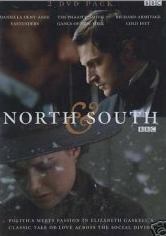
I am currently reading the book North and South. I watched the BBC mini-series based on the novel by Elizabeth Gaskell, and I fell in love with the storyline. The story is of a strong-minded young woman who grew up in the wealthier south of England and is forced to move to the industrial north after her father gives up his profession as an Anglican vicar. Margaret is found guilty of romanticizing the south as she experiences the people and ideals valued by the north. This story deals with the issues of the day of the Victorian Age, such as the value of education vs. hard work, religion vs. work time, social status vs. relationships, and of course, the north vs. the south. Margaret begins to see that she has been prejudiced against the north and many of its people. Eventually, Margaret's eyes are opened to see the beauty of the north and its industry.
I started reading the novel with Matt (see reading buddies below), and I am excited to see how it compares and contrasts to the mini-series. The ending of the book has a lot to live up to since the end of the mini-series is one of the most perfect endings (in my opinion) of all time. So far, the book has been very good, and the mini-series appears to have stuck pretty close to the book's plot.
I am one of those readers who does not like being held responsible for giving away the plot of a book, but I will introduce another character of the book, Mr. Thornton. Mr. Thornton is the owner of one of the cotton mills of Milton. At first, Mr. Thornton appears a very hot-tempered, abrasive, and prideful man who was lucky enough to be blessed with such good fortune as to be the master of a cotton mill. Is Margaret's first instinct about this man correct, or is Margaret simply jumping to conclusions? Only time and the reading of the novel (or the watching of the mini-series) will tell. Below are the first two clips of the mini-series, North and South. Hope you enjoy!
"For nine hundred years, Precious Auntie's family had been bonesetters. That was the tradition. Her father's customers were mostly men and boys who were crushed in the coal mines and limestone quarries. He treated other maladies when necessary, but bonesetting was his specialty. He did not have to go to a special school to be a bone doctor. He learned from watching his father, and his father learned from his father before him. That was their inheritance. They also passed along the secret location for finding the best dragon bones, a place called the Monkey's Jaw. An ancestor from the time of the Sung Dynasty had found the cave in the deepest ravines of the dry riverbed. Each generation dug deeper and deeper, with one soft crack in the cave leading to another farther in. And the secret of the exact location was also a family heirloom, passed from generation to generation, father to son, and in Precious Auntie's time, father to daughter to me."
The Bonesetter's Daughter is a book that has definitely impacted my life. Tan's book explores the complexity of the mother-daughter relationship across generations, showing that no matter how distant you may feel from each other, there is a connection between the two of you that can never be broken. Ruth, the main character, and her mother show both a literal and figurative loss of voice in this novel, portraying the silence of the female voice.
My junior honors English teacher recommended this book to me in high school. While reading this novel, you are sent on an emotional roller-coaster, connecting you to the book's characters and conflicts on a deep and personal level. This book has taught me many lessons such as to not judge others and to simply stop and just listen. Not much can be said about what The Bonesetter's Daughter has taught me without giving too much away, but this book has changed my life. This book is a favorite of mine, and I hope that it can touch the lives of future readers like it has touched me in my life.
I am a lover of quotes. The following are two of my favorite lines from this novel: